跳至主要内容

268 篇文章 含有標籤「leetcode」

檢視所有標籤

72. Edit Distance

· 閱讀時間約 2 分鐘
/*
* @lc app=leetcode id=72 lang=cpp
*
* [72] Edit Distance
*
* https://leetcode.com/problems/edit-distance/description/
*
* algorithms
* Medium (57.62%)
* Likes: 15237
* Dislikes: 249
* Total Accepted: 1M
* Total Submissions: 1.8M
* Testcase Example: '"horse"\n"ros"'
*
* Given two strings word1 and word2, return the minimum number of operations
* required to convert word1 to word2.
*
* You have the following three operations permitted on a word:
*
*
* Insert a character
* Delete a character
* Replace a character
*
*
*
* Example 1:
*
*
* Input: word1 = "horse", word2 = "ros"
* Output: 3
* Explanation:
* horse -> rorse (replace 'h' with 'r')
* rorse -> rose (remove 'r')
* rose -> ros (remove 'e')
*
*
* Example 2:
*
*
* Input: word1 = "intention", word2 = "execution"
* Output: 5
* Explanation:
* intention -> inention (remove 't')
* inention -> enention (replace 'i' with 'e')
* enention -> exention (replace 'n' with 'x')
* exention -> exection (replace 'n' with 'c')
* exection -> execution (insert 'u')
*
*
*
* Constraints:
*
*
* 0 <= word1.length, word2.length <= 500
* word1 and word2 consist of lowercase English letters.
*
*
*/

// @lc code=start
class Solution {
public:
int minDistance(string word1, string word2)
{
int m = word1.size(), n = word2.size();
vector<vector<int>> dp(m + 1, vector<int>(n + 1));

for (int i = 0; i <= m; ++i) dp[i][0] = i;
for (int j = 0; j <= n; ++j) dp[0][j] = j;

for (int i = 1; i <= m; ++i) {
for (int j = 1; j <= n; ++j) {
if (word1[i - 1] == word2[j - 1]) {
dp[i][j] = dp[i - 1][j - 1];
} else {
dp[i][j] = 1 + min({dp[i - 1][j - 1], dp[i - 1][j], dp[i][j - 1]});
}
}
}
return dp[m][n];
}
};
// @lc code=end
  • T: $O(M \cdot N)$
  • S: $O(M \cdot N)$

71. Simplify Path

· 閱讀時間約 1 分鐘
class Solution {
public:
string simplifyPath(string path)
{
vector<string> dir;
stringstream ss(path);
string token;
while(getline(ss, token, '/'))
{
if(token == "..")
{
if (!dir.empty()) dir.pop_back();
}
else if (!token.empty() && token != ".")
{
dir.push_back(token);
}
}
string res;
for (auto s : dir) res += "/" + s;
return res.empty() ? "/" : res;
}
};
  • T: $O(n)$
  • S: $O(n)$

70. Climbing Stairs

· 閱讀時間約 2 分鐘
/*
* @lc app=leetcode id=70 lang=cpp
*
* [70] Climbing Stairs
*
* https://leetcode.com/problems/climbing-stairs/description/
*
* algorithms
* Easy (53.10%)
* Likes: 22131
* Dislikes: 862
* Total Accepted: 3.5M
* Total Submissions: 6.7M
* Testcase Example: '2'
*
* You are climbing a staircase. It takes n steps to reach the top.
*
* Each time you can either climb 1 or 2 steps. In how many distinct ways can
* you climb to the top?
*
*
* Example 1:
*
*
* Input: n = 2
* Output: 2
* Explanation: There are two ways to climb to the top.
* 1. 1 step + 1 step
* 2. 2 steps
*
*
* Example 2:
*
*
* Input: n = 3
* Output: 3
* Explanation: There are three ways to climb to the top.
* 1. 1 step + 1 step + 1 step
* 2. 1 step + 2 steps
* 3. 2 steps + 1 step
*
*
*
* Constraints:
*
*
* 1 <= n <= 45
*
*
*/

// @lc code=start
class Solution {
public:
int climbStairs(int n)
{
if(n < 2) return n;

vector<int> dp(n + 1);

dp[0] = 1, dp[1] = 1;

for(int i = 2; i <= n; i++)
{
dp[i] = dp[i - 1] + dp[i - 2];
}
return dp[n];
}
};
// @lc code=end
  • T: $O(N)$

  • S: $O(N)$

  • DP improved

class Solution {
public:
int climbStairs(int n)
{
int previousStep = 1, currentStep = 1;
for(int step = 2; step <= n; step++)
{
int nextStep = previousStep + currentStep;
previousStep = currentStep;
currentStep = nextStep;
}
return currentStep;
}
};
  • T: $O(N)$
  • S: $O(1)$

68. Text Justification

· 閱讀時間約 1 分鐘
class Solution {
public:
vector<string> fullJustify(vector<string>& words, int maxWidth)
{
int n = words.size();
int start = 0;
vector<string> res;
while (start < n)
{
int last = start, totalChars = 0;
while (last < n && totalChars + words[last].size() + last - start <= maxWidth)
{
totalChars += words[last++].size();
}

string cur;

int space = maxWidth - totalChars;

for (int k = start; k < last; ++k)
{
cur += words[k];
if (space > 0)
{
int cnt;

if (last == n)
{
if (last - k == 1)
{
cnt = space;
}
else
{
cnt = 1;
}
}
else
{
if (last - k > 1)
{
if (space % (last - k - 1) == 0)
{
cnt = space / (last - k - 1);
}
else
{
cnt = space / (last - k - 1) + 1;
}
}
else
{
cnt = space;
}
}
cur.append(cnt, ' ');
space -= cnt;
}
}
res.push_back(cur);
start = last;
}
return res;
}
};
  • T: $O(n \cdot k)$
  • S: $O(m)$

65. Valid Number

· 閱讀時間約 3 分鐘

Hint

class Solution {
public:
bool isNumber(string s)
{
// Check if the string is empty; if so, it's not a valid number
// ex: s = ""

// Remove trailing spaces
// ex: s = "123 "

// Remove leading spaces
// ex: s = " 123"

// Indicates if a decimal point has been encountered
// Indicates if 'e' (exponent) has been encountered
// Indicates if any digit has been encountered

// Iterate through each character in the string
for ()
{
// Convert character to lowercase for uniform processing

// Check if the current character is a digit
if ()
{

}
// Check if the current character is a decimal point
else if ()
{
// Decimal point is not allowed if 'e' has been encountered or if there's already a decimal point
// ex: s = "99e2.5"
}
// Check if the current character is 'e' (exponent)
else if ()
{
// 'e' is not allowed if it has already been encountered or if there are no digits before it
// ex: s = "95a54e53", s = "e797537"
// Reset digit flag for the part after 'e'
}
// Check if the current character is a sign (+ or -)
else if ()
{
// A sign can only appear at the start or immediately after 'e'
}
else // Invalid character
}

// The string is valid if and only if at least one digit was found
}
};
class Solution {
public:
bool isNumber(string s)
{
// Check if the string is empty; if so, it's not a valid number
if (s.empty()) return false;

// Remove trailing spaces
while (s.back() == ' ') s.pop_back();

// Remove leading spaces
while (s.front() == ' ') s.erase(s.begin());

bool dot = false; // Indicates if a decimal point has been encountered
bool e = false; // Indicates if 'e' (exponent) has been encountered
bool digit = false; // Indicates if any digit has been encountered

// Iterate through each character in the string
for (int i = 0; i < s.size(); ++i)
{
s[i] = tolower(s[i]); // Convert character to lowercase for uniform processing

// Check if the current character is a digit
if (isdigit(s[i]))
{
digit = true;
}
// Check if the current character is a decimal point
else if (s[i] == '.')
{
// Decimal point is not allowed if 'e' has been encountered or if there's already a decimal point
if (e || dot) return false;
dot = true;
}
// Check if the current character is 'e' (exponent)
else if (s[i] == 'e')
{
// 'e' is not allowed if it has already been encountered or if there are no digits before it
if (e || !digit) return false;
e = true;
digit = false; // Reset digit flag for the part after 'e'
}
// Check if the current character is a sign (+ or -)
else if (s[i] == '-' || s[i] == '+')
{
// A sign can only appear at the start or immediately after 'e'
if (i != 0 && s[i - 1] != 'e') return false;
}
else return false; // Invalid character
}

// The string is valid if and only if at least one digit was found
return digit;
}
};

  • T: $O(n)$
  • S: $O(1)$

64. Minimum Path Sum

· 閱讀時間約 2 分鐘
/*
* @lc app=leetcode id=64 lang=cpp
*
* [64] Minimum Path Sum
*
* https://leetcode.com/problems/minimum-path-sum/description/
*
* algorithms
* Medium (64.84%)
* Likes: 12556
* Dislikes: 172
* Total Accepted: 1.3M
* Total Submissions: 2M
* Testcase Example: '[[1,3,1],[1,5,1],[4,2,1]]'
*
* Given a m x n grid filled with non-negative numbers, find a path from top
* left to bottom right, which minimizes the sum of all numbers along its
* path.
*
* Note: You can only move either down or right at any point in time.
*
*
* Example 1:
*
*
* Input: grid = [[1,3,1],[1,5,1],[4,2,1]]
* Output: 7
* Explanation: Because the path 1 → 3 → 1 → 1 → 1 minimizes the sum.
*
*
* Example 2:
*
*
* Input: grid = [[1,2,3],[4,5,6]]
* Output: 12
*
*
*
* Constraints:
*
*
* m == grid.length
* n == grid[i].length
* 1 <= m, n <= 200
* 0 <= grid[i][j] <= 200
*
*
*/

// @lc code=start
class Solution {
public:
int minPathSum(vector<vector<int>>& grid)
{
int m = grid.size(), n = grid[0].size();

for (int i = 1; i < m; ++i)
{
grid[i][0] += grid[i - 1][0];
}

for (int j = 1; j < n; ++j)
{
grid[0][j] += grid[0][j - 1];
}

for (int i = 1; i < m; ++i)
{
for (int j = 1; j < n; ++j)
{
grid[i][j] += min(grid[i - 1][j], grid[i][j - 1]);
}
}
return grid[m - 1][n - 1];
}
};
// @lc code=end
  • T: $O(M \cdot N)$
  • S: $O(1)$

63. Unique Paths II

· 閱讀時間約 2 分鐘
/*
* @lc app=leetcode id=63 lang=cpp
*
* [63] Unique Paths II
*
* https://leetcode.com/problems/unique-paths-ii/description/
*
* algorithms
* Medium (42.37%)
* Likes: 8964
* Dislikes: 521
* Total Accepted: 1.1M
* Total Submissions: 2.5M
* Testcase Example: '[[0,0,0],[0,1,0],[0,0,0]]'
*
* You are given an m x n integer array grid. There is a robot initially
* located at the top-left corner (i.e., grid[0][0]). The robot tries to move
* to the bottom-right corner (i.e., grid[m - 1][n - 1]). The robot can only
* move either down or right at any point in time.
*
* An obstacle and space are marked as 1 or 0 respectively in grid. A path that
* the robot takes cannot include any square that is an obstacle.
*
* Return the number of possible unique paths that the robot can take to reach
* the bottom-right corner.
*
* The testcases are generated so that the answer will be less than or equal to
* 2 * 10^9.
*
*
* Example 1:
*
*
* Input: obstacleGrid = [[0,0,0],[0,1,0],[0,0,0]]
* Output: 2
* Explanation: There is one obstacle in the middle of the 3x3 grid above.
* There are two ways to reach the bottom-right corner:
* 1. Right -> Right -> Down -> Down
* 2. Down -> Down -> Right -> Right
*
*
* Example 2:
*
*
* Input: obstacleGrid = [[0,1],[0,0]]
* Output: 1
*
*
*
* Constraints:
*
*
* m == obstacleGrid.length
* n == obstacleGrid[i].length
* 1 <= m, n <= 100
* obstacleGrid[i][j] is 0 or 1.
*
*
*/

// @lc code=start
class Solution {
public:
int uniquePathsWithObstacles(vector<vector<int>>& obstacleGrid)
{
int m = obstacleGrid.size(), n = obstacleGrid[0].size();

vector<vector<int>> dp(m, vector<int>(n));

dp[0][0] = obstacleGrid[0][0] ? 0 : 1;

for (int i = 1; i < m; i++)
{
dp[i][0] = !obstacleGrid[i][0] && dp[i - 1][0] ? 1 : 0;
}
for (int j = 1; j < n; j++)
{
dp[0][j] = !obstacleGrid[0][j] && dp[0][j - 1] ? 1 : 0;
}
for (int i = 1; i < m; i++)
{
for (int j = 1; j < n; j++)
{
if (!obstacleGrid[i][j])
{
dp[i][j] = dp[i - 1][j] + dp[i][j - 1];
}
}
}
return dp[m - 1][n - 1];
}
};
// @lc code=end
  • T: $O(M \cdot N)$
  • S: $O(M \cdot N)$

62. Unique Paths

· 閱讀時間約 2 分鐘
/*
* @lc app=leetcode id=62 lang=cpp
*
* [62] Unique Paths
*
* https://leetcode.com/problems/unique-paths/description/
*
* algorithms
* Medium (65.00%)
* Likes: 16985
* Dislikes: 457
* Total Accepted: 2.1M
* Total Submissions: 3.2M
* Testcase Example: '3\n7'
*
* There is a robot on an m x n grid. The robot is initially located at the
* top-left corner (i.e., grid[0][0]). The robot tries to move to the
* bottom-right corner (i.e., grid[m - 1][n - 1]). The robot can only move
* either down or right at any point in time.
*
* Given the two integers m and n, return the number of possible unique paths
* that the robot can take to reach the bottom-right corner.
*
* The test cases are generated so that the answer will be less than or equal
* to 2 * 10^9.
*
*
* Example 1:
*
*
* Input: m = 3, n = 7
* Output: 28
*
*
* Example 2:
*
*
* Input: m = 3, n = 2
* Output: 3
* Explanation: From the top-left corner, there are a total of 3 ways to reach
* the bottom-right corner:
* 1. Right -> Down -> Down
* 2. Down -> Down -> Right
* 3. Down -> Right -> Down
*
*
*
* Constraints:
*
*
* 1 <= m, n <= 100
*
*
*/

// @lc code=start
class Solution {
public:
int uniquePaths(int m, int n)
{
vector<vector<int>> dp(m, vector<int>(n, 1));
for (int i = 1; i < m; i++)
{
for (int j = 1; j < n; j++)
{
dp[i][j] = dp[i - 1][j] + dp[i][j - 1];
}
}
return dp[m - 1][n - 1];
}
};
// @lc code=end
  • T: $O(M \cdot N)$
  • S: $O(M \cdot N)$

61. Rotate List

· 閱讀時間約 2 分鐘

Given the head of a linked list, rotate the list to the right by k places.

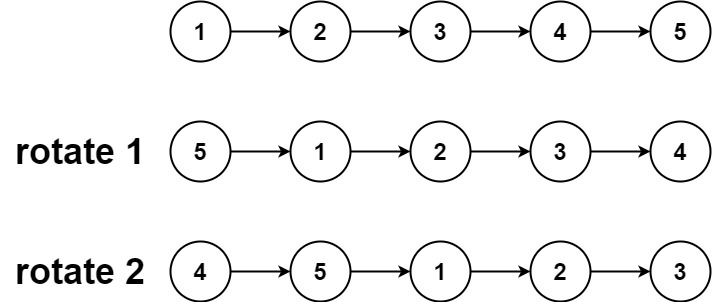
Example 1:

image

Input: head = [1,2,3,4,5], k = 2 Output: [4,5,1,2,3]

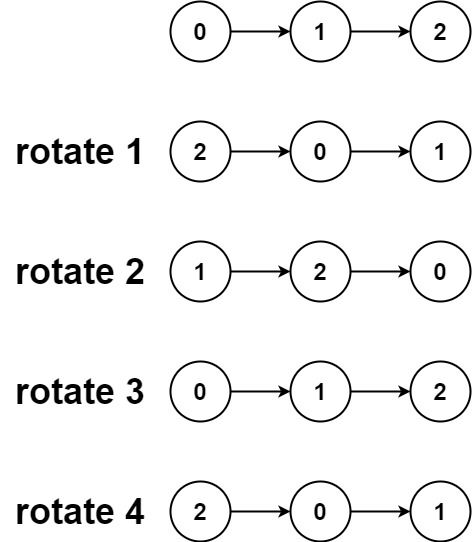
Example 2:

image

Input: head = [0,1,2], k = 4 Output: [2,0,1]

Constraints:

  • The number of nodes in the list is in the range [0, 500].
  • -100 <= Node.val <= 100
  • 0 <= k <= 2 * 109
/**
* Definition for singly-linked list.
* struct ListNode {
* int val;
* ListNode *next;
* ListNode() : val(0), next(nullptr) {}
* ListNode(int x) : val(x), next(nullptr) {}
* ListNode(int x, ListNode *next) : val(x), next(next) {}
* };
*/
class Solution {
public:
ListNode* rotateRight(ListNode* head, int k) {
// base case
if (!head || !head->next) return head;

// 計算 linked list 長度
ListNode* cur = head;
int n = 1;
while(cur->next) {
cur = cur->next;
++n;
}

// 接成一個環
cur->next = head;

// 因為也有 k 大於 n 的情況
// 所以這裡要做 k %= n 處理
k %= n;

// 再用一個 new_tail pointer 指向 head
// 新的節點的頭是從末端數回來第 k 個節點,所以是 n - k
ListNode* new_tail = head;
for (int i = 0; i < n - k - 1; ++i) {
// new_tail 移到新的節點的頭
new_tail = new_tail->next;
}

// 新的節點的 head = new_tail->next
// 以 head = [1, 2, 3, 4, 5] 這個例子來說
// 現在的 new_head 指向 4
ListNode* new_head = new_tail->next;

// 斷開環
// 以 head = [1, 2, 3, 4, 5] 這個例子來說
// 現在的 new_tail 指向 3,所以 new_tail->next 要指向 NULL
new_tail->next = nullptr;
// 最後 retrun 新的起始點 head
return new_head;
}
};
  • T: $O(N)$
  • S: $O(1)$