跳至主要内容

268 篇文章 含有標籤「leetcode」

檢視所有標籤

658. Find K Closest Elements

· 閱讀時間約 1 分鐘

Given a sorted integer array arr, two integers k and x, return the k closest integers to x in the array. The result should also be sorted in ascending order.

An integer a is closer to x than an integer b if:

  • |a - x| < |b - x|, or
  • |a - x| == |b - x| and a < b

Example 1:

Input: arr = [1,2,3,4,5], k = 4, x = 3 Output: [1,2,3,4]

Example 2:

Input: arr = [1,2,3,4,5], k = 4, x = -1 Output: [1,2,3,4]

Constraints:

  • 1 <= k <= arr.length
  • 1 <= arr.length <= 104
  • arr is sorted in ascending order.
  • -104 <= arr[i], x <= 104
class Solution {
public:
vector<int> findClosestElements(vector<int>& arr, int k, int x) {
while (arr.size() > k) {
if (x - arr.front() > arr.back() - x) {
// 如果 x - arr.front() 的差大於 arr.back() - x 的話
// 代表 arr.front() 離中心點 x 比較遠
// 這時候就 erase 前面
arr.erase(arr.begin());
} else {
// 如果 arr.back() - x 的差大於 x - arr.front() 的話
// 代表 arr.back() 離中心點 x 比較遠
// 這時候就 pop_back() 後面
arr.pop_back();
}
}
return arr;
}
};
  • T: $O(\log(N) + K)$
  • S: $O(1)$

650. 2 Keys Keyboard

· 閱讀時間約 2 分鐘
/*
* @lc app=leetcode id=650 lang=cpp
*
* [650] 2 Keys Keyboard
*
* https://leetcode.com/problems/2-keys-keyboard/description/
*
* algorithms
* Medium (59.60%)
* Likes: 4264
* Dislikes: 243
* Total Accepted: 270.7K
* Total Submissions: 454.1K
* Testcase Example: '3'
*
* There is only one character 'A' on the screen of a notepad. You can perform
* one of two operations on this notepad for each step:
*
*
* Copy All: You can copy all the characters present on the screen (a partial
* copy is not allowed).
* Paste: You can paste the characters which are copied last time.
*
*
* Given an integer n, return the minimum number of operations to get the
* character 'A' exactly n times on the screen.
*
*
* Example 1:
*
*
* Input: n = 3
* Output: 3
* Explanation: Initially, we have one character 'A'.
* In step 1, we use Copy All operation.
* In step 2, we use Paste operation to get 'AA'.
* In step 3, we use Paste operation to get 'AAA'.
*
*
* Example 2:
*
*
* Input: n = 1
* Output: 0
*
*
*
* Constraints:
*
*
* 1 <= n <= 1000
*
*
*/

// @lc code=start
class Solution {
public:
int minSteps(int n)
{
int count = 0;
for (int i = 2; i <= n; i++)
{
while (n % i == 0)
{
count += i;
n /= i;
}
}
return count;
}
};
// @lc code=end
  • T: O(sqrt(N))
  • S: O(1)

648. Replace Words

· 閱讀時間約 3 分鐘

In English, we have a concept called root, which can be followed by some other word to form another longer word - let's call this word derivative. For example, when the root "help" is followed by the word "ful", we can form a derivative "helpful".

Given a dictionary consisting of many roots and a sentence consisting of words separated by spaces, replace all the derivatives in the sentence with the root forming it. If a derivative can be replaced by more than one root, replace it with the root that has the shortest length.

Return the sentence after the replacement.

Example 1:

Input: dictionary = ["cat","bat","rat"], sentence = "the cattle was rattled by the battery" Output: "the cat was rat by the bat"

Example 2:

Input: dictionary = ["a","b","c"], sentence = "aadsfasf absbs bbab cadsfafs" Output: "a a b c"

Constraints:

  • 1 <= dictionary.length <= 1000
  • 1 <= dictionary[i].length <= 100
  • dictionary[i] consists of only lower-case letters.
  • 1 <= sentence.length <= 106
  • sentence consists of only lower-case letters and spaces.
  • The number of words in sentence is in the range [1, 1000]
  • The length of each word in sentence is in the range [1, 1000]
  • Every two consecutive words in sentence will be separated by exactly one space.
  • sentence does not have leading or trailing spaces.
class TrieNode {
public:
TrieNode* child[26];
bool isWord = false;
TrieNode() {
for(int i = 0; i < 26; i++) {
child[i] = nullptr;
}
}
};

class Trie {
private:
TrieNode* root;

public:
Trie() {
root = new TrieNode();
}

void insert(string word) {
TrieNode* node = root;
for(auto c : word) {
if(!node->child[c - 'a']) {
node->child[c - 'a'] = new TrieNode();
}
node = node->child[c - 'a'];
}
node->isWord = true;
}

string searchShortestRoot(string word) {
TrieNode* node = root;
// 用一個 prefix 字串儲存最短 root
string prefix = "";
for (char c : word) {
// 當發現沒有在字典樹內的時候,break,並且返回 word
if (!node->child[c - 'a']) break;
prefix.push_back(c);
node = node->child[c - 'a'];
// 輸入的 word 已經是最短 root 的狀況
if (node->isWord) return prefix;
}
return word;
}
};

class Solution {
public:
string replaceWords(vector<string>& dictionary, string sentence) {
stringstream ss(sentence);
Trie t;
// 將 root push 到 trie
for(auto word : dictionary) {
t.insert(word);
}
string token;
string res;
// 用 string stream 的方式尋找 word
// 如果找到的話,replace word with root
while (getline(ss, token, ' ')) {
res += t.searchShortestRoot(token) + " ";
}
res.pop_back();
return res;
}
};
  • T: $O(d \cdot w + s \cdot w)$
  • S: $O(d \cdot w + s \cdot w)$

637. Average of Levels in Binary Tree

· 閱讀時間約 1 分鐘
/**
* Definition for a binary tree node.
* struct TreeNode {
* int val;
* TreeNode *left;
* TreeNode *right;
* TreeNode() : val(0), left(nullptr), right(nullptr) {}
* TreeNode(int x) : val(x), left(nullptr), right(nullptr) {}
* TreeNode(int x, TreeNode *left, TreeNode *right) : val(x), left(left), right(right) {}
* };
*/
#define ll long long

class Solution {
public:
vector<double> averageOfLevels(TreeNode* root)
{
vector<double> res;
queue<TreeNode*> q{{root}};
while (!q.empty())
{
int qSize = q.size();
double sum = 0;
for (int i = 0; i < qSize; ++i)
{
TreeNode* node = q.front(); q.pop();
sum += node->val;
if (node->left) q.push(node->left);
if (node->right) q.push(node->right);
}
res.push_back(sum / qSize);
}
return res;
}
};
  • T: $O(n)$
  • S: $O(m)$

572. Subtree of Another Tree

· 閱讀時間約 2 分鐘

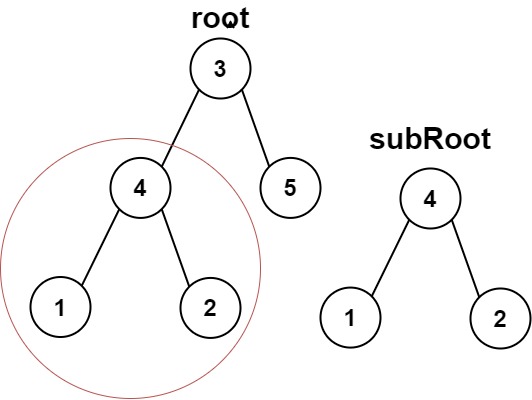
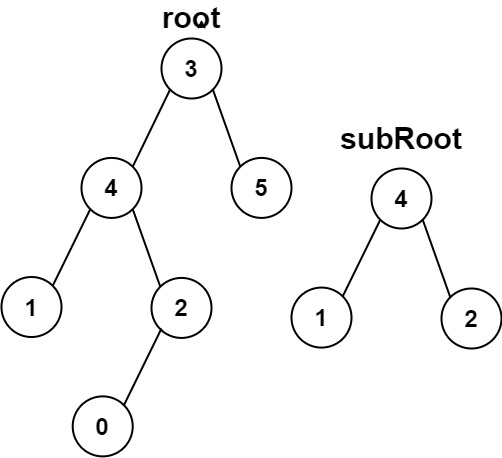
Given the roots of two binary trees root and subRoot, return true if there is a subtree of root with the same structure and node values of subRoot and false otherwise.

A subtree of a binary tree tree is a tree that consists of a node in tree and all of this node's descendants. The tree tree could also be considered as a subtree of itself.

Example 1:

image

Input: root = [3,4,5,1,2], subRoot = [4,1,2] Output: true

Example 2:

image

Input: root = [3,4,5,1,2,null,null,null,null,0], subRoot = [4,1,2] Output: false

Constraints:

  • The number of nodes in the root tree is in the range [1, 2000].
  • The number of nodes in the subRoot tree is in the range [1, 1000].
  • -104 <= root.val <= 104
  • -104 <= subRoot.val <= 104
/**
* Definition for a binary tree node.
* struct TreeNode {
* int val;
* TreeNode *left;
* TreeNode *right;
* TreeNode() : val(0), left(nullptr), right(nullptr) {}
* TreeNode(int x) : val(x), left(nullptr), right(nullptr) {}
* TreeNode(int x, TreeNode *left, TreeNode *right) : val(x), left(left), right(right) {}
* };
*/
class Solution {
public:
bool isSubtree(TreeNode* root, TreeNode* subRoot) {
// base case
if (!subRoot) return true;
if (!root) return false;

// 如果相符就 return true
if (isSame(root, subRoot)) return true;

// 檢查左邊、檢查右邊,只要其中一邊有 subtree 就 return true
return isSubtree(root->left, subRoot) || isSubtree(root->right, subRoot);

}
bool isSame(TreeNode* t1, TreeNode* t2) {
if (!t1 && !t2) return true;
if (!t1 || !t2) return false;
if (t1->val != t2->val) return false;
return isSame(t1->left, t2->left) && isSame(t1->right, t2->right);
}
};
  • T: $O(M \cdot N)$
  • S: $O(M + N)$

547. Number of Provinces

· 閱讀時間約 2 分鐘

Union Find

/*
* @lc app=leetcode id=547 lang=cpp
*
* [547] Number of Provinces
*
* https://leetcode.com/problems/number-of-provinces/description/
*
* algorithms
* Medium (67.05%)
* Likes: 9841
* Dislikes: 367
* Total Accepted: 981.9K
* Total Submissions: 1.5M
* Testcase Example: '[[1,1,0],[1,1,0],[0,0,1]]'
*
* There are n cities. Some of them are connected, while some are not. If city
* a is connected directly with city b, and city b is connected directly with
* city c, then city a is connected indirectly with city c.
*
* A province is a group of directly or indirectly connected cities and no
* other cities outside of the group.
*
* You are given an n x n matrix isConnected where isConnected[i][j] = 1 if the
* i^th city and the j^th city are directly connected, and isConnected[i][j] =
* 0 otherwise.
*
* Return the total number of provinces.
*
*
* Example 1:
*
*
* Input: isConnected = [[1,1,0],[1,1,0],[0,0,1]]
* Output: 2
*
*
* Example 2:
*
*
* Input: isConnected = [[1,0,0],[0,1,0],[0,0,1]]
* Output: 3
*
*
*
* Constraints:
*
*
* 1 <= n <= 200
* n == isConnected.length
* n == isConnected[i].length
* isConnected[i][j] is 1 or 0.
* isConnected[i][i] == 1
* isConnected[i][j] == isConnected[j][i]
*
*
*/

// @lc code=start
class UnionFind {
private:
vector<int> parent;
vector<int> rank;
public:
UnionFind(int n)
{
parent.resize(n);
rank.resize(n, 1);
for (int i = 0; i < n; i++)
{
parent[i] = i;
}
}

int find(int x)
{
if (x != parent[x])
{
parent[x] = find(parent[x]);
}
return parent[x];
}

void unionNodes(int n1, int n2)
{
int p1 = find(n1);
int p2 = find(n2);

if (p1 == p2) return;

if (rank[p1] > rank[p2])
{
parent[p2] = p1;
rank[p1] += rank[p2];
}
else
{
parent[p1] = p2;
rank[p2] += rank[p1];
}
}
};

class Solution {
public:
int findCircleNum(vector<vector<int>>& isConnected)
{
int n = isConnected.size();
UnionFind uf(n);

int cnt = n;
for (int i = 0; i < n; i++)
{
for (int j = i + 1; j < n; j++)
{
if (isConnected[i][j] && uf.find(i) != uf.find(j))
{
cnt--;
uf.unionNodes(i, j);
}
}
}
return cnt;
}
};
// @lc code=end
  • T: $O(n^2)$
  • S: $O(n)$

543. Diameter of Binary Tree

· 閱讀時間約 2 分鐘

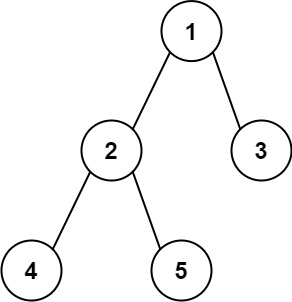
Given the root of a binary tree, return the length of the diameter of the tree.

The diameter of a binary tree is the length of the longest path between any two nodes in a tree. This path may or may not pass through the root.

The length of a path between two nodes is represented by the number of edges between them.

Example 1:

image

Input: root = [1,2,3,4,5] Output: 3 Explanation: 3 is the length of the path [4,2,1,3] or [5,2,1,3].

Example 2:

Input: root = [1,2] Output: 1

Constraints:

  • The number of nodes in the tree is in the range [1, 104].
  • -100 <= Node.val <= 100

算 Binary Tree 的直徑,dfs 解

/**
* Definition for a binary tree node.
* struct TreeNode {
* int val;
* TreeNode *left;
* TreeNode *right;
* TreeNode() : val(0), left(nullptr), right(nullptr) {}
* TreeNode(int x) : val(x), left(nullptr), right(nullptr) {}
* TreeNode(int x, TreeNode *left, TreeNode *right) : val(x), left(left), right(right) {}
* };
*/
class Solution {
private:
int diameter = 0;
public:
int diameterOfBinaryTree(TreeNode* root) {
dfs(root);
return diameter;
}

int dfs(TreeNode* root) {
if(!root) return 0;
// 走訪左邊的 tree
int left = dfs(root->left);

// 走訪右邊的 tree
int right = dfs(root->right);

// 算最大的直徑
diameter = max(diameter, left + right);

// 每次遞迴,要記得直徑 + 1
return 1 + max(left, right);
}
};
  • T: $O(N)$
  • S: $O(N)$

542. 01 Matrix

· 閱讀時間約 2 分鐘

BFS

/*
* @lc app=leetcode id=542 lang=cpp
*
* [542] 01 Matrix
*
* https://leetcode.com/problems/01-matrix/description/
*
* algorithms
* Medium (49.81%)
* Likes: 9993
* Dislikes: 434
* Total Accepted: 696.7K
* Total Submissions: 1.4M
* Testcase Example: '[[0,0,0],[0,1,0],[0,0,0]]'
*
* Given an m x n binary matrix mat, return the distance of the nearest 0 for
* each cell.
*
* The distance between two cells sharing a common edge is 1.
*
*
* Example 1:
*
*
* Input: mat = [[0,0,0],[0,1,0],[0,0,0]]
* Output: [[0,0,0],[0,1,0],[0,0,0]]
*
*
* Example 2:
*
*
* Input: mat = [[0,0,0],[0,1,0],[1,1,1]]
* Output: [[0,0,0],[0,1,0],[1,2,1]]
*
*
*
* Constraints:
*
*
* m == mat.length
* n == mat[i].length
* 1 <= m, n <= 10^4
* 1 <= m * n <= 10^4
* mat[i][j] is either 0 or 1.
* There is at least one 0 in mat.
*
*
*
* Note: This question is the same as 1765:
* https://leetcode.com/problems/map-of-highest-peak/
*
*/

// @lc code=start
class Solution {
public:
vector<vector<int>> updateMatrix(vector<vector<int>>& mat)
{
int m = mat.size(), n = mat[0].size();
queue<vector<int>> q;
set<pair<int, int>> used;
for (int i = 0; i < m; i++)
{
for (int j = 0; j < n; j++)
{
if (mat[i][j] == 0)
{
q.push({i, j, 0});
used.insert({i, j});
}
}
}

vector<vector<int>> res = mat;
vector<vector<int>> directions = {{0, 1}, {0, -1}, {1, 0}, {-1, 0}};
while (!q.empty())
{
auto node = q.front(); q.pop();
for (const auto& dir : directions)
{
int new_i = node[0] + dir[0];
int new_j = node[1] + dir[1];
int dist = node[2] + 1;

if (new_i < 0 || new_j < 0 || new_i >= m || new_j >= n || used.count({new_i, new_j})) continue;
q.push({new_i, new_j, dist});
used.insert({new_i, new_j});
res[new_i][new_j] = dist;
}
}
return res;
}
};
// @lc code=end
  • T: $O(M \cdot N)$
  • S: $O(M \cdot N)$

539. Minimum Time Difference

· 閱讀時間約 1 分鐘

Hint

class Solution {
public:
int findMinDifference(vector<string>& timePoints)
{
int n = timePoints.size();
vector<int> minutes(n);
for (int i = 0; i < n; i++)
{
int h = stoi(timePoints[i].substr(0, 2));
int m = stoi(timePoints[i].substr(3));
minutes[i] = (h * 60 + m);
}

sort(minutes.begin(), minutes.end());

int res = 1440;
for (int i = 0; i < n - 1; i++)
{
res = min(res, minutes[i + 1] - minutes[i]);
}
return min(res, 24 * 60 - (minutes[n - 1] - minutes[0]));
}
};
  • T: $O()$
  • S: $O()$