跳至主要内容

268 篇文章 含有標籤「leetcode」

檢視所有標籤

739. Daily Temperatures

· 閱讀時間約 1 分鐘

Given an array of integers temperatures represents the daily temperatures, return an array answer such that answer[i] is the number of days you have to wait after the ith day to get a warmer temperature. If there is no future day for which this is possible, keep answer[i] == 0 instead.

Example 1:

Input: temperatures = [73,74,75,71,69,72,76,73] Output: [1,1,4,2,1,1,0,0]

Example 2:

Input: temperatures = [30,40,50,60] Output: [1,1,1,0]

Example 3:

Input: temperatures = [30,60,90] Output: [1,1,0]

Constraints:

  • 1 <= temperatures.length <= 105
  • 30 <= temperatures[i] <= 100
class Solution {
public:
vector<int> dailyTemperatures(vector<int>& temperatures) {
int n = temperatures.size();
stack<int> st;
vector<int> res(n);
for(int i = 0; i < n; i++) {
// 當遇到溫度是比較高的時候
while(!st.empty() && temperatures[i] > temperatures[st.top()]) {
// 拿到前一天的 index
int previousDay = st.top(); st.pop();

// 計算 index 差,也就是差幾天
int dayDiff = i - previousDay;

// 將結果存到 res
res[previousDay] = dayDiff;
}
// 將 index 存到 stack
st.push(i);
}
return res;
}
};
  • T: $O(N)$
  • S: $O(N)$

733. Flood Fill

· 閱讀時間約 1 分鐘
  • DFS
class Solution {
public:
vector<vector<int>> floodFill(vector<vector<int>>& image, int sr, int sc, int color)
{
int originalColor = image[sr][sc];
if (color == originalColor) return image;
dfs(image, sr, sc, color, originalColor);
return image;
}

void dfs(vector<vector<int>>& image, int i, int j, int color, int originalColor)
{
if (i < 0 || j < 0 || i >= image.size() || j >= image[0].size() || image[i][j] == color || image[i][j] != originalColor)
return;

image[i][j] = color;

vector<vector<int>> directions = {{0, 1}, {0, -1}, {1, 0}, {-1, 0}};
for (const auto& dir : directions)
{
dfs(image, i + dir[0], j + dir[1], color, originalColor);
}
}
};
  • T: $O(m \cdot n)$。
  • S: $O(1)$。

725. Split Linked List in Parts

· 閱讀時間約 1 分鐘

Hint

/**
* Definition for singly-linked list.
* struct ListNode {
* int val;
* ListNode *next;
* ListNode() : val(0), next(nullptr) {}
* ListNode(int x) : val(x), next(nullptr) {}
* ListNode(int x, ListNode *next) : val(x), next(next) {}
* };
*/
class Solution {
public:
vector<ListNode*> splitListToParts(ListNode* head, int k)
{
int n = 0;
ListNode* cur = head;
while (cur)
{
n++;
cur = cur->next;
}

int splitSize = n / k;
int remaining = n % k;

vector<ListNode*> res(k);
cur = head;
for (int i = 0; i < k; i++)
{
ListNode* partHead = cur;
int partSize = splitSize + (remaining > 0 ? 1 : 0);
remaining--;

for (int j = 0; j < partSize - 1 && cur; j++)
{
cur = cur->next;
}

if (cur) {
ListNode* nextPart = cur->next;
cur->next = nullptr;
cur = nextPart;
}
res[i] = (partHead);
}
return res;
}
};
  • T: $O(n)$
  • S: $O(n)$

721. Accounts Merge

· 閱讀時間約 4 分鐘

Hint - Union Find

class UnionFind {
private:
// Stores the parent of each node
// Stores the rank (or depth) of each node

public:
// Constructor: Initialize parent and rank vectors
UnionFind()
{
// Resize parent vector to hold n elements
// Initialize rank vector with 1 for all elements
// Set each node to be its own parent
}

// Find the root of the set containing x, with path compression
int find()
{
}

// Union the sets containing n1 and n2
void unionNodes()
{
// Find the root of the set containing n1
// Find the root of the set containing n2
// If they are already in the same set, do nothing

// Union by rank
if ()
{
// Attach smaller tree to larger tree
}
else if ()
{
// Attach smaller tree to larger tree
}
else
{
// Attach second tree to first and increase rank
}
}
};

class Solution {
public:
vector<vector<string>> accountsMerge(vector<vector<string>>& accounts)
{
// Number of accounts
// Create UnionFind instance with n nodes
// Maps email to account index

// Iterate through each account
for ()
{
// Iterate through each email in the account
for ()
{
if ()
{
// Union the current account with the account that already has this email
}
else
{
// Map the email to the current account index
}
}
}

// Maps root account index to list of emails
// Collect emails for each connected component
for ()
{
}

// Result vector to store merged accounts
// Prepare the final result
for ()
{
// Get the username
// Initialize group with the username
// Sort emails in lexicographical order
// Add emails to group
// Add group to result
}
// Return the merged accounts
}
};
  • Union Find
class UnionFind {
private:
vector<int> parent; // Stores the parent of each node
vector<int> rank; // Stores the rank (or depth) of each node

public:
// Constructor: Initialize parent and rank vectors
UnionFind(int n)
{
parent.resize(n); // Resize parent vector to hold n elements
rank.resize(n, 1); // Initialize rank vector with 1 for all elements
for (int i = 0; i < n; i++) parent[i] = i; // Set each node to be its own parent
}

// Find the root of the set containing x, with path compression
int find(int x)
{
if (x != parent[x])
{
parent[x] = find(parent[x]); // Path compression
}
return parent[x];
}

// Union the sets containing n1 and n2
void unionNodes(int n1, int n2)
{
int p1 = find(n1); // Find the root of the set containing n1
int p2 = find(n2); // Find the root of the set containing n2
if (p1 == p2) return; // If they are already in the same set, do nothing

// Union by rank
if (rank[p1] > rank[p2])
{
parent[p2] = p1; // Attach smaller tree to larger tree
}
else if (rank[p1] < rank[p2])
{
parent[p1] = p2; // Attach smaller tree to larger tree
}
else
{
parent[p2] = p1; // Attach second tree to first and increase rank
rank[p1]++;
}
}
};

class Solution {
public:
// Merge accounts with the same email
vector<vector<string>> accountsMerge(vector<vector<string>>& accounts)
{
int n = accounts.size(); // Number of accounts
UnionFind uf(n); // Create UnionFind instance with n nodes
unordered_map<string, int> emailMap; // Maps email to account index

// Iterate through each account
for (int i = 0; i < n; i++)
{
// Iterate through each email in the account
for (int j = 1; j < accounts[i].size(); j++)
{
string email = accounts[i][j];
if (emailMap.count(email))
{
// Union the current account with the account that already has this email
uf.unionNodes(emailMap[email], i);
}
else
{
// Map the email to the current account index
emailMap[email] = i;
}
}
}

unordered_map<int, vector<string>> mergeMap; // Maps root account index to list of emails
// Collect emails for each connected component
for (auto& [email, accountIdx] : emailMap)
{
mergeMap[uf.find(accountIdx)].push_back(email);
}

vector<vector<string>> res; // Result vector to store merged accounts
// Prepare the final result
for (auto& [accountIndex, emails] : mergeMap)
{
string user = accounts[accountIndex][0]; // Get the username
vector<string> group = {user}; // Initialize group with the username
sort(emails.begin(), emails.end()); // Sort emails in lexicographical order
group.insert(group.end(), emails.begin(), emails.end()); // Add emails to group
res.push_back(group); // Add group to result
}

return res; // Return the merged accounts
}
};
  • T: $O(n \cdot k \cdot \log (n \cdot k))$
  • S: $O(n \cdot k)$

704. Binary Search

· 閱讀時間約 1 分鐘
/*
* @lc app=leetcode id=704 lang=cpp
*
* [704] Binary Search
*
* https://leetcode.com/problems/binary-search/description/
*
* algorithms
* Easy (58.66%)
* Likes: 12543
* Dislikes: 272
* Total Accepted: 3.1M
* Total Submissions: 5.3M
* Testcase Example: '[-1,0,3,5,9,12]\n9'
*
* Given an array of integers nums which is sorted in ascending order, and an
* integer target, write a function to search target in nums. If target exists,
* then return its index. Otherwise, return -1.
*
* You must write an algorithm with O(log n) runtime complexity.
*
*
* Example 1:
*
*
* Input: nums = [-1,0,3,5,9,12], target = 9
* Output: 4
* Explanation: 9 exists in nums and its index is 4
*
*
* Example 2:
*
*
* Input: nums = [-1,0,3,5,9,12], target = 2
* Output: -1
* Explanation: 2 does not exist in nums so return -1
*
*
*
* Constraints:
*
*
* 1 <= nums.length <= 10^4
* -10^4 < nums[i], target < 10^4
* All the integers in nums are unique.
* nums is sorted in ascending order.
*
*
*/

// @lc code=start
class Solution {
public:
int search(vector<int>& nums, int target) {
int left = 0, right = nums.size() - 1;
while(left <= right) {
int mid = left + (right - left) / 2;
if(nums[mid] == target) {
return mid;
} else if(nums[mid] < target) {
++left;
} else {
--right;
}
}
return -1;
}
};
// @lc code=end

695. Max Area of Island

· 閱讀時間約 3 分鐘
/*
* @lc app=leetcode id=695 lang=cpp
*
* [695] Max Area of Island
*
* https://leetcode.com/problems/max-area-of-island/description/
*
* algorithms
* Medium (72.62%)
* Likes: 10244
* Dislikes: 212
* Total Accepted: 1M
* Total Submissions: 1.4M
* Testcase Example: '[[0,0,1,0,0,0,0,1,0,0,0,0,0],[0,0,0,0,0,0,0,1,1,1,0,0,0],[0,1,1,0,1,0,0,0,0,0,0,0,0],[0,1,0,0,1,1,0,0,1,0,1,0,0],[0,1,0,0,1,1,0,0,1,1,1,0,0],[0,0,0,0,0,0,0,0,0,0,1,0,0],[0,0,0,0,0,0,0,1,1,1,0,0,0],[0,0,0,0,0,0,0,1,1,0,0,0,0]]'
*
* You are given an m x n binary matrix grid. An island is a group of 1's
* (representing land) connected 4-directionally (horizontal or vertical.) You
* may assume all four edges of the grid are surrounded by water.
*
* The area of an island is the number of cells with a value 1 in the island.
*
* Return the maximum area of an island in grid. If there is no island, return
* 0.
*
*
* Example 1:
*
*
* Input: grid =
* [[0,0,1,0,0,0,0,1,0,0,0,0,0],[0,0,0,0,0,0,0,1,1,1,0,0,0],[0,1,1,0,1,0,0,0,0,0,0,0,0],[0,1,0,0,1,1,0,0,1,0,1,0,0],[0,1,0,0,1,1,0,0,1,1,1,0,0],[0,0,0,0,0,0,0,0,0,0,1,0,0],[0,0,0,0,0,0,0,1,1,1,0,0,0],[0,0,0,0,0,0,0,1,1,0,0,0,0]]
* Output: 6
* Explanation: The answer is not 11, because the island must be connected
* 4-directionally.
*
*
* Example 2:
*
*
* Input: grid = [[0,0,0,0,0,0,0,0]]
* Output: 0
*
*
*
* Constraints:
*
*
* m == grid.length
* n == grid[i].length
* 1 <= m, n <= 50
* grid[i][j] is either 0 or 1.
*
*
*/

// @lc code=start
class Solution {
public:
int maxAreaOfIsland(vector<vector<int>>& grid)
{
int maxArea = 0;
for (int i = 0; i < grid.size(); i++)
{
for (int j = 0; j < grid[0].size(); j++)
{
maxArea = max(maxArea, dfs(grid, i, j));
}
}
return maxArea;
}

int dfs(vector<vector<int>>& grid, int i, int j)
{
if (i < 0 || j < 0 || i >= grid.size() || j >= grid[0].size() || grid[i][j] == 0)
{
return 0;
}

int area = 1;
grid[i][j] = 0;
vector<vector<int>> directions = {{0, -1}, {0, 1}, {1, 0}, {-1, 0}};
for (const auto& dir : directions)
{
area += dfs(grid, i + dir[0], j + dir[1]);
}
return area;
}
};
// @lc code=end
  • T: $O(M \cdot N)$
  • S: $O(M \cdot N)$
class Solution {
public:
int maxAreaOfIsland(vector<vector<int>>& grid)
{
int maxArea = 0;
vector<vector<int>> directions = {{0, -1}, {0, 1}, {1, 0}, {-1, 0}};
for (int i = 0; i < grid.size(); i++)
{
for (int j = 0; j < grid[0].size(); j++)
{
if (grid[i][j] == 0) continue;
int area = 1;
queue<vector<int>> q;
q.push({i, j});
grid[i][j] = 0;
while (!q.empty())
{
auto node = q.front(); q.pop();
for (const auto& dir : directions)
{
int new_i = node[0] + dir[0];
int new_j = node[1] + dir[1];
if (new_i < 0 || new_j < 0 || new_i >= grid.size() || new_j >= grid[0].size() || grid[new_i][new_j] == 0)
continue;

grid[new_i][new_j] = 0;
area++;
q.push({new_i, new_j});
}
}
maxArea = max(maxArea, area);
}
}
return maxArea;
}
};
  • T: $O(M \cdot N)$
  • S: $O(M \cdot N)$

692. Top K Frequent Words

· 閱讀時間約 2 分鐘

Given an array of strings words and an integer k, return the k most frequent strings.

Return the answer sorted by the frequency from highest to lowest. Sort the words with the same frequency by their lexicographical order.

Example 1:

Input: words = ["i","love","leetcode","i","love","coding"], k = 2 Output: ["i","love"] Explanation: "i" and "love" are the two most frequent words. Note that "i" comes before "love" due to a lower alphabetical order.

Example 2:

Input: words = ["the","day","is","sunny","the","the","the","sunny","is","is"], k = 4 Output: ["the","is","sunny","day"] Explanation: "the", "is", "sunny" and "day" are the four most frequent words, with the number of occurrence being 4, 3, 2 and 1 respectively.

Constraints:

  • 1 <= words.length <= 500
  • 1 <= words[i].length <= 10
  • words[i] consists of lowercase English letters.
  • k is in the range [1, The number of **unique** words[i]]

Follow-up: Could you solve it in O(n log(k)) time and O(n) extra space?

class Solution {
public:
vector<string> topKFrequent(vector<string>& words, int k) {
// res 最多就 k 的長度
vector<string> res(k);

// 計算每個單字的頻率
unordered_map<string, int> freq;
for (auto word : words) ++freq[word];

auto cmp = [](pair<string, int>& a, pair<string, int>& b) {
// a.second > b.second 比較頻率
// priority_queue 和 sort custom compare 的順序相反
// 如果頻率是由小排到大的話,會是 a.second > b.second

// 如果出現頻率一樣的話,a.second == b.second && a.first < b.first
// 比較字串
return a.second > b.second || (a.second == b.second && a.first < b.first);
};
priority_queue<pair<string, int>, vector<pair<string, int>>, decltype(cmp)> pq(cmp);

for (auto f : freq) {
pq.push(f);
// 維持 k 的長度,如果太長就 pop 掉,從頻率少的開始 popup
if (pq.size() > k) pq.pop();
}

// 因為這時候的 priority queue 是從小排到大
// 所以從 res 的最後面開始裝
for (int i = res.size() - 1; i >= 0; --i) {
res[i] = pq.top().first; pq.pop();
}
return res;
}
};
  • T: $O(N)$
  • S: $O(N)$

684. Redundant Connection

· 閱讀時間約 2 分鐘
/*
* @lc app=leetcode id=684 lang=cpp
*
* [684] Redundant Connection
*
* https://leetcode.com/problems/redundant-connection/description/
*
* algorithms
* Medium (63.65%)
* Likes: 6822
* Dislikes: 434
* Total Accepted: 528K
* Total Submissions: 798.6K
* Testcase Example: '[[1,2],[1,3],[2,3]]'
*
* In this problem, a tree is an undirected graph that is connected and has no
* cycles.
*
* You are given a graph that started as a tree with n nodes labeled from 1 to
* n, with one additional edge added. The added edge has two different vertices
* chosen from 1 to n, and was not an edge that already existed. The graph is
* represented as an array edges of length n where edges[i] = [ai, bi]
* indicates that there is an edge between nodes ai and bi in the graph.
*
* Return an edge that can be removed so that the resulting graph is a tree of
* n nodes. If there are multiple answers, return the answer that occurs last
* in the input.
*
*
* Example 1:
*
*
* Input: edges = [[1,2],[1,3],[2,3]]
* Output: [2,3]
*
*
* Example 2:
*
*
* Input: edges = [[1,2],[2,3],[3,4],[1,4],[1,5]]
* Output: [1,4]
*
*
*
* Constraints:
*
*
* n == edges.length
* 3 <= n <= 1000
* edges[i].length == 2
* 1 <= ai < bi <= edges.length
* ai != bi
* There are no repeated edges.
* The given graph is connected.
*
*
*/

// @lc code=start
class UnionFind {
private:
vector<int> parent;
vector<int> rank;
public:
UnionFind(int n) {
parent.resize(n + 1);
rank.resize(n + 1);
for (int i = 0; i <= n; ++i) {
parent[i] = i;
rank[i] = 1;
}
}

int find(int x) {
if(parent[x] != x) {
parent[x] = find(parent[x]);
}
return parent[x];
}

void merge(int n1, int n2) {
int p1 = find(n1);
int p2 = find(n2);

if(p1 == p2) return;

if(rank[p1] > rank[p2]) {
parent[p2] = p1;
rank[p1] += rank[p2];
} else {
parent[p1] = p2;
rank[p2] += rank[p1];
}
}
};

class Solution {
public:
vector<int> findRedundantConnection(vector<vector<int>>& edges) {
int n = edges.size();
UnionFind uf(n);
for (const auto& edge : edges) {
if (uf.find(edge[0]) == uf.find(edge[1])) {
return edge;
}
uf.merge(edge[0], edge[1]);
}
return {};
}
};
// @lc code=end
  • T: $O(N)$
  • S: $O(N)$

662. Maximum Width of Binary Tree

· 閱讀時間約 3 分鐘

Given the root of a binary tree, return the maximum width of the given tree.

The maximum width of a tree is the maximum width among all levels.

The width of one level is defined as the length between the end-nodes (the leftmost and rightmost non-null nodes), where the null nodes between the end-nodes that would be present in a complete binary tree extending down to that level are also counted into the length calculation.

It is guaranteed that the answer will in the range of a 32-bit signed integer.

Example 1:

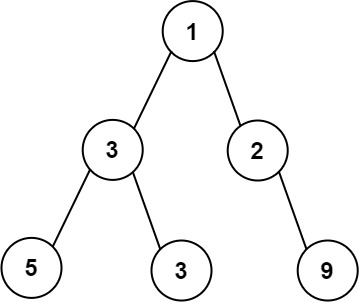
image

Input: root = [1,3,2,5,3,null,9] Output: 4 Explanation: The maximum width exists in the third level with length 4 (5,3,null,9).

Example 2:

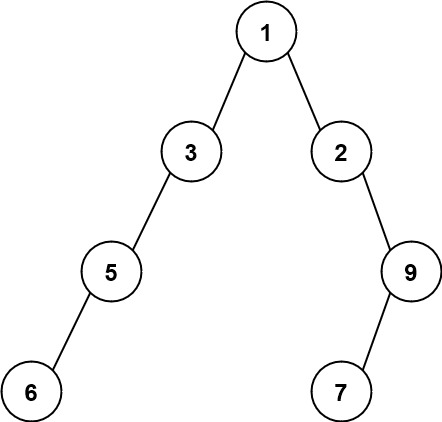
image

Input: root = [1,3,2,5,null,null,9,6,null,7] Output: 7 Explanation: The maximum width exists in the fourth level with length 7 (6,null,null,null,null,null,7).

Example 3:

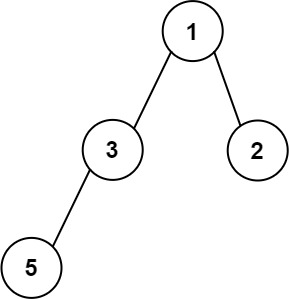
image

Input: root = [1,3,2,5] Output: 2 Explanation: The maximum width exists in the second level with length 2 (3,2).

Constraints:

  • The number of nodes in the tree is in the range [1, 3000].
  • -100 <= Node.val <= 100
/**
* Definition for a binary tree node.
* struct TreeNode {
* int val;
* TreeNode *left;
* TreeNode *right;
* TreeNode() : val(0), left(nullptr), right(nullptr) {}
* TreeNode(int x) : val(x), left(nullptr), right(nullptr) {}
* TreeNode(int x, TreeNode *left, TreeNode *right) : val(x), left(left), right(right) {}
* };
*/
#define ll long long

class Solution {
public:
int widthOfBinaryTree(TreeNode* root) {
if(!root) return 0;
// 使用 pair 的結構 {目前的節點, 節點的 index}
queue<pair<TreeNode*, ll>> q;
q.push({root, 0});

ll maxWidth = 0;
while(!q.empty()) {
ll qSize = q.size();
// 最左邊 node 的 index
ll left = q.front().second;
// 最右邊 node 的 index
ll right = q.back().second;

// 寬度公式:右邊節點的 index - 左邊節點的 index + 1
maxWidth = max(maxWidth, right - left + 1);

// 走訪每一層
for(int i = 0; i < qSize; i++) {
auto node = q.front(); q.pop();
// levelIndex = 目前節點的 index - 最左邊節點的 index
ll levelIndex = node.second - left;
if(node.first->left) {
// 將左邊節點推到 queue
q.push({node.first->left, 2 * levelIndex});
}
if(node.first->right) {
// 將右邊節點推到 queue
q.push({node.first->right, 2 * levelIndex + 1});
}
}
}
return maxWidth;
}
};
  • T: $O(N)$
  • S: $O(N)$