跳至主要内容

1328. Break a Palindrome

· 閱讀時間約 1 分鐘
  • 將迴文改成不是迴文。
  • 考慮只有一個字母的情況:abc
  • 走訪字串的一半,遇到不是 a 的字母改成 a,這樣就不是 palindrome 了。
  • 考慮連續 a 的情況,例如aaa
class Solution {
public:
string breakPalindrome(string palindrome)
{
int n = palindrome.size();
if (n == 1)
{
return "";
}

for (int i = 0; i < n / 2; ++i)
{
if (palindrome[i] != 'a')
{
palindrome[i] = 'a';
return palindrome;
}
}
palindrome.back() = 'b';
return palindrome;
}
};
  • T: $O(n)$
  • S: $O(n)$

1190. Reverse Substrings Between Each Pair of Parentheses

· 閱讀時間約 1 分鐘

Hint

class Solution {
public:
string reverseParentheses(string s)
{
// Stack to keep track of the positions of '('

// Result string to build the final output

// Iterate through each character in the input string
for ()
{
if ()
{
// When encountering '(', push the current size of res onto the stack
// This marks the position to start reversing later

}
else if ()
{
// When encountering ')', get the position of the matching '('

// Reverse the substring within the parentheses

}
else
{
// For any other character, append it to the result string

}
}
// Return the final modified string

}
};
  • Brute Force
class Solution {
public:
string reverseParentheses(string s)
{
stack<int> stk;
string res;

for (char c : s)
{
if (c == '(')
{
stk.push(res.size());
}
else if (c == ')')
{
int start = stk.top(); stk.pop();
reverse(res.begin() + start, res.end());
}
else
{
res += c;
}
}
return res;
}
};
  • T: $O(n^2)$
  • S: $O(n)$

1143. Longest Common Subsequence

· 閱讀時間約 2 分鐘
/*
* @lc app=leetcode id=1143 lang=cpp
*
* [1143] Longest Common Subsequence
*
* https://leetcode.com/problems/longest-common-subsequence/description/
*
* algorithms
* Medium (57.74%)
* Likes: 13643
* Dislikes: 199
* Total Accepted: 1.2M
* Total Submissions: 2.1M
* Testcase Example: '"abcde"\n"ace"'
*
* Given two strings text1 and text2, return the length of their longest common
* subsequence. If there is no common subsequence, return 0.
*
* A subsequence of a string is a new string generated from the original string
* with some characters (can be none) deleted without changing the relative
* order of the remaining characters.
*
*
* For example, "ace" is a subsequence of "abcde".
*
*
* A common subsequence of two strings is a subsequence that is common to both
* strings.
*
*
* Example 1:
*
*
* Input: text1 = "abcde", text2 = "ace"
* Output: 3
* Explanation: The longest common subsequence is "ace" and its length is 3.
*
*
* Example 2:
*
*
* Input: text1 = "abc", text2 = "abc"
* Output: 3
* Explanation: The longest common subsequence is "abc" and its length is 3.
*
*
* Example 3:
*
*
* Input: text1 = "abc", text2 = "def"
* Output: 0
* Explanation: There is no such common subsequence, so the result is 0.
*
*
*
* Constraints:
*
*
* 1 <= text1.length, text2.length <= 1000
* text1 and text2 consist of only lowercase English characters.
*
*
*/

// @lc code=start
class Solution {
public:
int longestCommonSubsequence(string text1, string text2)
{
int m = text1.size(), n = text2.size();
vector<vector<int>> dp(m + 1, vector<int>(n + 1));
for (int i = 1; i < m + 1; ++i)
{
for (int j = 1; j < n + 1; ++j)
{
if (text1[i - 1] == text2[j - 1])
{
dp[i][j] = dp[i - 1][j - 1] + 1;
}
else
{
dp[i][j] = max(dp[i - 1][j], dp[i][j - 1]);
}
}
}
return dp[m][n];
}
};
// @lc code=end
  • T: $O(M \cdot N)$
  • S: $O(M \cdot N)$

1123. Lowest Common Ancestor of Deepest Leaves

· 閱讀時間約 3 分鐘

Hint

/**
* Definition for a binary tree node.
* struct TreeNode {
* int val;
* TreeNode *left;
* TreeNode *right;
* TreeNode() : val(0), left(nullptr), right(nullptr) {}
* TreeNode(int x) : val(x), left(nullptr), right(nullptr) {}
* TreeNode(int x, TreeNode *left, TreeNode *right) : val(x), left(left), right(right) {}
* };
*/

class Solution {
public:
TreeNode* lcaDeepestLeaves(TreeNode* root)
{
// If the tree is empty, return nullptr

// Get the depth of the left and right subtrees

// If the depths are equal, the current node is the LCA of the deepest leaves

// If the left subtree is deeper, continue the search in the left subtree

// Otherwise, continue the search in the right subtree
}

// This method calculates the depth of a given node
int getDepth(TreeNode* node)
{
// If the node is null, return 0 as the depth
// Recursively get the depth of the left and right subtrees and add 1 for the current node
}
};
/**
* Definition for a binary tree node.
* struct TreeNode {
* int val;
* TreeNode *left;
* TreeNode *right;
* TreeNode() : val(0), left(nullptr), right(nullptr) {}
* TreeNode(int x) : val(x), left(nullptr), right(nullptr) {}
* TreeNode(int x, TreeNode *left, TreeNode *right) : val(x), left(left), right(right) {}
* };
*/
class Solution {
public:
TreeNode* lcaDeepestLeaves(TreeNode* root)
{
if (!root) return nullptr;

int left = getDepth(root->left);
int right = getDepth(root->right);

if (left == right) return root;
return (left > right) ? lcaDeepestLeaves(root->left) : lcaDeepestLeaves(root->right);
}

int getDepth(TreeNode* node)
{
if (!node) return 0;
return 1 + max(getDepth(node->left), getDepth(node->right));
}
};
  • T: $O(n^2)$
  • S: $O(h)$

Hint - Optimization

/**
* Definition for a binary tree node.
* struct TreeNode {
* int val;
* TreeNode *left;
* TreeNode *right;
* TreeNode() : val(0), left(nullptr), right(nullptr) {}
* TreeNode(int x) : val(x), left(nullptr), right(nullptr) {}
* TreeNode(int x, TreeNode *left, TreeNode *right) : val(x), left(left), right(right) {}
* };
*/

class Solution {
public:
TreeNode* lcaDeepestLeaves(TreeNode* root)
{
// Start the depth-first search from the root
}

// This method performs a depth-first search and returns a pair containing the LCA and the depth
pair<TreeNode*, int> dfs(TreeNode* node)
{
// If the node is null, return {nullptr, 0} indicating a depth of 0

// Recursively perform DFS on the left and right subtrees

// If the left subtree is deeper, return the left LCA and increase the depth by 1
// If the right subtree is deeper, return the right LCA and increase the depth by 1
// If both subtrees have the same depth, the current node is the LCA
}
};
  • Optimization
/**
* Definition for a binary tree node.
* struct TreeNode {
* int val;
* TreeNode *left;
* TreeNode *right;
* TreeNode() : val(0), left(nullptr), right(nullptr) {}
* TreeNode(int x) : val(x), left(nullptr), right(nullptr) {}
* TreeNode(int x, TreeNode *left, TreeNode *right) : val(x), left(left), right(right) {}
* };
*/
class Solution {
public:
TreeNode* lcaDeepestLeaves(TreeNode* root)
{
return dfs(root).first;
}
pair<TreeNode*, int> dfs(TreeNode* node)
{
if (!node) return {nullptr, 0};

auto left = dfs(node->left);
auto right = dfs(node->right);

if (left.second > right.second) return {left.first, left.second + 1};
if (left.second < right.second) return {right.first, right.second + 1};
return {node, left.second + 1};
}
};
  • T: $O(n)$
  • S: $O(h)$

1122. Relative Sort Array

· 閱讀時間約 1 分鐘
  • 使用 TreeMap
class Solution {
public:
vector<int> relativeSortArray(vector<int>& arr1, vector<int>& arr2)
{
map<int, int> countMap;
for (int num : arr1) ++countMap[num];

vector<int> res;
for (int num : arr2)
{
for (int i = 0; i < countMap[num]; ++i)
{
res.push_back(num);
}
countMap.erase(num);
}

for (auto a : countMap)
{
for (int i = 0; i < a.second; ++i)
{
res.push_back(a.first);
}
}
return res;
}
};
  • T: $O(n + m + k)$
  • S: $O(k)$

1110. Delete Nodes And Return Forest

· 閱讀時間約 2 分鐘

Hint - Recursion

/**
* Definition for a binary tree node.
* struct TreeNode {
* int val;
* TreeNode *left;
* TreeNode *right;
* TreeNode() : val(0), left(nullptr), right(nullptr) {}
* TreeNode(int x) : val(x), left(nullptr, right(nullptr) {}
* TreeNode(int x, TreeNode *left, TreeNode *right) : val(x), left(left), right(right) {}
* };
*/
class Solution {
public:
vector<TreeNode*> delNodes(TreeNode* root, vector<int>& to_delete)
{
// Vector to store the resulting forest of trees
// Convert the list of nodes to delete into a set for faster lookup
// Call the helper function to process the tree
// If the root is not deleted, add it to the forest
// Return the forest
}

// Helper function to process each node
helper()
{
// If the node is null, return null

// Recursively process the left and right subtrees

// If the current node is not in the set of nodes to delete, return it

// If the current node is to be deleted, add its children to the forest if they exist

// Delete the current node
// Return null to indicate the node has been deleted
}
};
  • Recursion
/**
* Definition for a binary tree node.
* struct TreeNode {
* int val;
* TreeNode *left;
* TreeNode *right;
* TreeNode() : val(0), left(nullptr), right(nullptr) {}
* TreeNode(int x) : val(x), left(nullptr), right(nullptr) {}
* TreeNode(int x, TreeNode *left, TreeNode *right) : val(x), left(left), right(right) {}
* };
*/
class Solution {
public:
vector<TreeNode*> delNodes(TreeNode* root, vector<int>& to_delete)
{
vector<TreeNode*> forest;
unordered_set<int> st(to_delete.begin(), to_delete.end());
root = helper(root, st, forest);
if (root) forest.push_back(root);
return forest;
}

TreeNode* helper(TreeNode* node, unordered_set<int>& st, vector<TreeNode*>& forest)
{
if (!node) return nullptr;

node->left = helper(node->left, st, forest);
node->right = helper(node->right, st, forest);

if (!st.count(node->val)) return node;

if (node->left) forest.push_back(node->left);
if (node->right) forest.push_back(node->right);
delete node;
return nullptr;
}
};
  • T: $O(n)$
  • S: $O(n)$

1038. Binary Search Tree to Greater Sum Tree

· 閱讀時間約 1 分鐘
  • DFS
/**
* Definition for a binary tree node.
* struct TreeNode {
* int val;
* TreeNode *left;
* TreeNode *right;
* TreeNode() : val(0), left(nullptr), right(nullptr) {}
* TreeNode(int x) : val(x), left(nullptr), right(nullptr) {}
* TreeNode(int x, TreeNode *left, TreeNode *right) : val(x), left(left), right(right) {}
* };
*/
class Solution {
private:
int sum = 0;
public:
TreeNode* bstToGst(TreeNode* root)
{
dfs(root);
return root;
}

void dfs(TreeNode* root)
{
if (!root) return;
dfs(root->right);
root->val += sum;
sum = root->val;
dfs(root->left);
}
};
  • T: $O(n)$

  • S: $O(n)$

  • BFS

/**
* Definition for a binary tree node.
* struct TreeNode {
* int val;
* TreeNode *left;
* TreeNode *right;
* TreeNode() : val(0), left(nullptr), right(nullptr) {}
* TreeNode(int x) : val(x), left(nullptr), right(nullptr) {}
* TreeNode(int x, TreeNode *left, TreeNode *right) : val(x), left(left), right(right) {}
* };
*/
class Solution {
public:
TreeNode* bstToGst(TreeNode* root)
{
int sum = 0;
stack<TreeNode*> stk;
TreeNode* node = root;
while (node || !stk.empty())
{
while (node)
{
stk.push(node);
node = node->right;
}
node = stk.top(); stk.pop();
sum += node->val;
node->val = sum;
node = node->left;
}
return root;
}
};
  • T: $O(n)$
  • S: $O(n)$

994. Rotting Oranges

· 閱讀時間約 2 分鐘

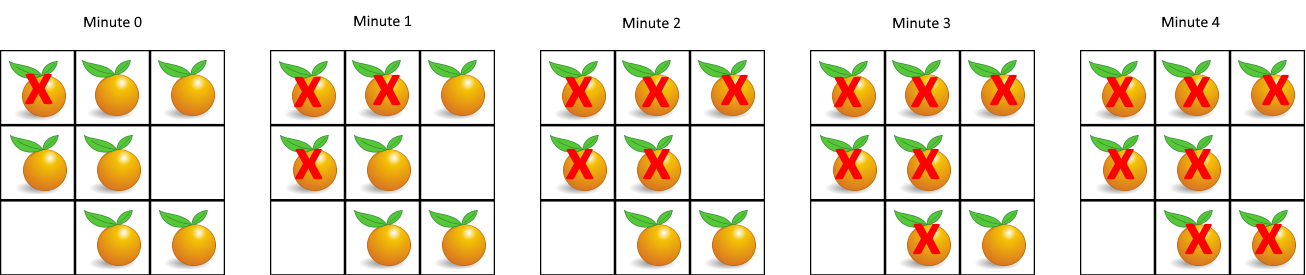
You are given an m x n grid where each cell can have one of three values:

  • 0 representing an empty cell,
  • 1 representing a fresh orange, or
  • 2 representing a rotten orange.

Every minute, any fresh orange that is 4-directionally adjacent to a rotten orange becomes rotten.

Return the minimum number of minutes that must elapse until no cell has a fresh orange. If this is impossible, return -1.

Example 1:

image

Input: grid = [[2,1,1],[1,1,0],[0,1,1]] Output: 4

Example 2:

Input: grid = [[2,1,1],[0,1,1],[1,0,1]] Output: -1 Explanation: The orange in the bottom left corner (row 2, column 0) is never rotten, because rotting only happens 4-directionally.

Example 3:

Input: grid = [[0,2]] Output: 0 Explanation: Since there are already no fresh oranges at minute 0, the answer is just 0.

Constraints:

  • m == grid.length
  • n == grid[i].length
  • 1 <= m, n <= 10
  • grid[i][j] is 0, 1, or 2.
class Solution {
public:
int orangesRotting(vector<vector<int>>& grid) {
int rows = grid.size(), cols = grid[0].size();

// 用來存花了多少分鐘
int minutes = 0;

// 用來存剩下多少橘子
int fresh = 0;
queue<pair<int, int>> q;
for(int i = 0; i < rows; i++) {
for(int j = 0; j < cols; j++) {
// 如果遇到 1,新鮮橘子 + 1
if(grid[i][j] == 1) fresh++;
// 如果遇到 2,壞橘子推到 queue
else if(grid[i][j] == 2) q.push({i, j});
}
}

vector<vector<int>> directions = {{0, 1}, {0, -1}, {1, 0}, {-1, 0}};

while(!q.empty() && fresh > 0) {
int qSize = q.size();
for(int i = 0; i < qSize; i++) {
auto node = q.front(); q.pop();
for(auto& dir : directions) {
int new_r = node.first + dir[0];
int new_c = node.second + dir[1];
// 遇到超出邊界的、不是好橘子的都略過
if(new_r < 0 || new_c < 0 || new_r >= rows || new_c >= cols || grid[new_r][new_c] != 1)
continue;

// 標記新的格子已經是壞橘子
grid[new_r][new_c] = 2;
q.push({new_r, new_c});
fresh--;
}
}
// queue 搜索完一輪,minutes++
minutes++;
}
// 判斷最後還有新鮮橘子,return -1
return fresh == 0 ? minutes : -1;
}
};
  • T: $O(M \cdot N)$
  • S: $O(M \cdot N)$

983. Minimum Cost For Tickets

· 閱讀時間約 3 分鐘
/*
* @lc app=leetcode id=983 lang=cpp
*
* [983] Minimum Cost For Tickets
*
* https://leetcode.com/problems/minimum-cost-for-tickets/description/
*
* algorithms
* Medium (65.25%)
* Likes: 8510
* Dislikes: 180
* Total Accepted: 418.4K
* Total Submissions: 620.7K
* Testcase Example: '[1,4,6,7,8,20]\n[2,7,15]'
*
* You have planned some train traveling one year in advance. The days of the
* year in which you will travel are given as an integer array days. Each day
* is an integer from 1 to 365.
*
* Train tickets are sold in three different ways:
*
*
* a 1-day pass is sold for costs[0] dollars,
* a 7-day pass is sold for costs[1] dollars, and
* a 30-day pass is sold for costs[2] dollars.
*
*
* The passes allow that many days of consecutive travel.
*
*
* For example, if we get a 7-day pass on day 2, then we can travel for 7 days:
* 2, 3, 4, 5, 6, 7, and 8.
*
*
* Return the minimum number of dollars you need to travel every day in the
* given list of days.
*
*
* Example 1:
*
*
* Input: days = [1,4,6,7,8,20], costs = [2,7,15]
* Output: 11
* Explanation: For example, here is one way to buy passes that lets you travel
* your travel plan:
* On day 1, you bought a 1-day pass for costs[0] = $2, which covered day 1.
* On day 3, you bought a 7-day pass for costs[1] = $7, which covered days 3,
* 4, ..., 9.
* On day 20, you bought a 1-day pass for costs[0] = $2, which covered day 20.
* In total, you spent $11 and covered all the days of your travel.
*
*
* Example 2:
*
*
* Input: days = [1,2,3,4,5,6,7,8,9,10,30,31], costs = [2,7,15]
* Output: 17
* Explanation: For example, here is one way to buy passes that lets you travel
* your travel plan:
* On day 1, you bought a 30-day pass for costs[2] = $15 which covered days 1,
* 2, ..., 30.
* On day 31, you bought a 1-day pass for costs[0] = $2 which covered day 31.
* In total, you spent $17 and covered all the days of your travel.
*
*
*
* Constraints:
*
*
* 1 <= days.length <= 365
* 1 <= days[i] <= 365
* days is in strictly increasing order.
* costs.length == 3
* 1 <= costs[i] <= 1000
*
*
*/

// @lc code=start
class Solution {
public:
int mincostTickets(vector<int>& days, vector<int>& costs) {
int lastDay = days.back();
vector<int> dp(lastDay + 1, 0);

int i = 0;

for (int day = 1; day < lastDay + 1; day++) {
if (day < days[i]) {
dp[day] = dp[day - 1];
} else {
i++;

dp[day] = min({
dp[day - 1] + costs[0],
dp[max(0, day - 7)] + costs[1],
dp[max(0, day - 30)] + costs[2]});
}
}
return dp[lastDay];
}
};
// @lc code=end
  • T: $O(N)$
  • S: $O(N)$