跳至主要内容

30. Substring with Concatenation of All Words

· 閱讀時間約 2 分鐘
class Solution {
public:
vector<int> findSubstring(string s, vector<string>& words)
{
// 每個單字的長度都相同,為 n
int n = words[0].size();

// 計算總共有幾個單字
int wordCounts = words.size();

unordered_map<string,int> freq;

// 計算每個單字出現的頻率
for (int i = 0; i < wordCounts; i++)
{
freq[words[i]]++;
}

vector<int> res;

// 一個指標 start 走訪一個單字的長度 n
for (int start = 0; start < n; ++start)
{
// 兩個指標 i, j
// i 為右邊界
// j 為左邊界
int i = start;
int j = i;
int cnt = 0;

// 記錄目前的子串中每個單字的出現次數
unordered_map<string, int> m;

// 走訪字串 s
while (j < s.size())
{
// 如果子串中出現了一個不在 words 中的單字,清空 m,並且將指針 i 和 j 向前移動一個單字的長度。
if (!freq.count(s.substr(j, n)))
{
// 清空 m
m.clear();
// 清空 cnt
cnt = 0;
// i, j 跳到下一個起始點
j += n;
i = j;
}
// 如果子串中所有單字的出現次數均不超過 words 中該單字的出現次數,我們將指針 j 向前移動一個單字的長度,同時增加相應的計數。
else if (m[s.substr(j, n)] < freq[s.substr(j, n)])
{
m[s.substr(j, n)]++;
cnt++;
j += n;
}
// 如果子串中某個單字的出現次數超過了 words 中該單字的出現次數,我們將指針 i 向前移動一個單字的長度,同時將相應的計數減少。
else if (m[s.substr(j, n)] == m[s.substr(j, n)])
{
m[s.substr(i, n)]--;
i += n;
cnt--;
}

// 當找到一個包含 words 中所有單字的子串時,將其起始 index 加入結果 res 中。
if (cnt == wordCounts)
{
res.push_back(i);
m[s.substr(i, n)]--;
// i 向前移動 n 的距離
i += n;
cnt--;
}
}
}

return res;
}
};
  • T: $O()$
  • S: $O()$

28. Find the Index of the First Occurrence in a String

· 閱讀時間約 1 分鐘

Hint

class Solution {
public:
int strStr(string haystack, string needle)
{
// Iterate through 'haystack' from the start to the point where 'needle' can fit
for ()
{
// Iterate through each character in 'needle'
for ()
{
// If the characters don't match, break out of the inner loop

// If we reach the end of 'needle' and all characters have matched
if ()
{
// Return the starting index of the first occurrence of 'needle' in 'haystack'
}
}
}
// If 'needle' is not found in 'haystack', return -1
}
};
class Solution {
public:
int strStr(string haystack, string needle)
{
for (int i = 0; i <= haystack.size() - needle.size(); ++i)
{
for (int j = 0; j < needle.size(); ++j)
{
if (needle[j] != haystack[i + j]) break;
if (j == needle.size() - 1)
{
return i;
}
}
}
return -1;
}
};
  • T: $O(n * m)$
  • S: $O(1)$

27. Remove Element

· 閱讀時間約 1 分鐘

Hint

class Solution {
public:
int removeElement(vector<int>& nums, int val)
{
// Initialize a counter to keep track of the new length of the array
// Iterate through each element of the array
for ()
{
// If the current element is not equal to the value to be removed
if ()
{
// Assign the current element to the position indicated by cnt and increment cnt
}
}
// Return the new length of the array, which is the count of elements not equal to val
}
};
class Solution {
public:
int removeElement(vector<int>& nums, int val)
{
int cnt = 0;
for (int i = 0; i < nums.size(); ++i)
{
if (nums[i] != val)
{
nums[cnt++] = nums[i];
}
}
return cnt;
}
};
  • T: $O(N)$
  • S: $O(1)$

26. Remove Duplicates from Sorted Array

· 閱讀時間約 1 分鐘

Hint

class Solution {
public:
int removeDuplicates(vector<int>& nums)
{
// Initialize a counter to keep track of the unique elements' length

// Iterate through the array starting from the second element
for ()
{
// If the current element is different from the previous element
if ()
{
// Assign the current element to the position indicated by cnt and increment cnt
}
}
// Return the count of unique elements in the array
}
};
class Solution {
public:
int removeDuplicates(vector<int>& nums)
{
int cnt = 1;
for (int i = 1; i < nums.size(); ++i)
{
if (nums[i - 1] != nums[i])
{
nums[cnt++] = nums[i];
}
}
return cnt;
}
};
  • T: $O(N)$
  • S: $O(1)$

25. Reverse Nodes in k-Group

· 閱讀時間約 1 分鐘
  • Recursion
/**
* Definition for singly-linked list.
* struct ListNode {
* int val;
* ListNode *next;
* ListNode() : val(0), next(nullptr) {}
* ListNode(int x) : val(x), next(nullptr) {}
* ListNode(int x, ListNode *next) : val(x), next(next) {}
* };
*/
class Solution {
public:
ListNode* reverseKGroup(ListNode* head, int k)
{
// cnt 計算需要反轉的 node 的數量
int cnt = 0;
ListNode* cur = head;
// 當需要反轉的 node 的數量小於 k 的時候
// 指標前進
while (cur && cnt < k)
{
cur = cur->next;
cnt++;
}

// 當需要反轉的 node 數量達到 k 時
if (cnt == k)
{
// 呼叫 reverseLinkedList,反轉 linked list
ListNode* reversedHead = reverseLinkedList(head, k);

// 遞迴反轉剩餘的 node
head->next = reverseKGroup(cur, k);
return reversedHead;
}
return head;
}

ListNode* reverseLinkedList(ListNode* head, int k)
{
ListNode* dummy = new ListNode();
ListNode* cur = head;
for (int i = 0; i < k; ++i)
{
ListNode* next_node = cur->next;
cur->next = dummy;
dummy = cur;
cur = next_node;
}
return dummy;
}
};
  • T: $O(n)$

  • S: $O(n / k)$

  • Iteration

  • T: $O(n)$
  • S: $O(1)$

24. Swap Nodes in Pairs

· 閱讀時間約 1 分鐘
/**
* Definition for singly-linked list.
* struct ListNode {
* int val;
* ListNode *next;
* ListNode() : val(0), next(nullptr) {}
* ListNode(int x) : val(x), next(nullptr) {}
* ListNode(int x, ListNode *next) : val(x), next(next) {}
* };
*/
class Solution {
public:
ListNode* swapPairs(ListNode* head)
{
if (!head || !head->next) return head;
ListNode* first = head;
ListNode* second = head->next;

first->next = swapPairs(second->next);

second->next = first;
return second;
}
};
  • T: $O(N)$
  • S: $O(N)$

21. Merge Two Sorted Lists

· 閱讀時間約 1 分鐘
  • Recursion
/**
* Definition for singly-linked list.
* struct ListNode {
* int val;
* ListNode *next;
* ListNode() : val(0), next(nullptr) {}
* ListNode(int x) : val(x), next(nullptr) {}
* ListNode(int x, ListNode *next) : val(x), next(next) {}
* };
*/
class Solution {
public:
ListNode* mergeTwoLists(ListNode* list1, ListNode* list2)
{
if (!list1) return list2;
if (!list2) return list1;
if (list1->val < list2->val)
{
list1->next = mergeTwoLists(list1->next, list2);
return list1;
}
else
{
list2->next = mergeTwoLists(list2->next, list1);
return list2;
}
}
};
  • T: $O(n + m)$

  • S: $O(n + m)$

  • Iteration

/**
* Definition for singly-linked list.
* struct ListNode {
* int val;
* ListNode *next;
* ListNode() : val(0), next(nullptr) {}
* ListNode(int x) : val(x), next(nullptr) {}
* ListNode(int x, ListNode *next) : val(x), next(next) {}
* };
*/
class Solution {
public:
ListNode* mergeTwoLists(ListNode* list1, ListNode* list2)
{
ListNode* dummy = new ListNode(-1);
ListNode* cur = dummy;

while (list1 && list2)
{
if (list1->val < list2->val)
{
cur->next = list1;

list1 = list1->next;
}
else
{
cur->next = list2;
list2 = list2->next;
}
cur = cur->next;
}
if (!list1) cur->next = list2;
if (!list2) cur->next = list1;
return dummy->next;
}
};
  • T: $O(n + m)$
  • S: $O(1)$

20. Valid Parentheses

· 閱讀時間約 1 分鐘
/*
* @lc app=leetcode id=20 lang=cpp
*
* [20] Valid Parentheses
*
* https://leetcode.com/problems/valid-parentheses/description/
*
* algorithms
* Easy (41.30%)
* Likes: 25708
* Dislikes: 1873
* Total Accepted: 6M
* Total Submissions: 14.3M
* Testcase Example: '"()"'
*
* Given a string s containing just the characters '(', ')', '{', '}', '[' and
* ']', determine if the input string is valid.
*
* An input string is valid if:
*
*
* Open brackets must be closed by the same type of brackets.
* Open brackets must be closed in the correct order.
* Every close bracket has a corresponding open bracket of the same type.
*
*
*
* Example 1:
*
*
* Input: s = "()"
*
* Output: true
*
*
* Example 2:
*
*
* Input: s = "()[]{}"
*
* Output: true
*
*
* Example 3:
*
*
* Input: s = "(]"
*
* Output: false
*
*
* Example 4:
*
*
* Input: s = "([])"
*
* Output: true
*
*
*
* Constraints:
*
*
* 1 <= s.length <= 10^4
* s consists of parentheses only '()[]{}'.
*
*
*/

// @lc code=start
class Solution {
public:
bool isValid(string s) {
unordered_map<char, char> closeToOpen = {
{')', '('},
{']', '['},
{'}', '{'},
};
stack<char> stk;
for (const auto& c : s) {
if (closeToOpen.count(c)) {
if (!stk.empty() && stk.top() == closeToOpen[c]) stk.pop();
else return false;
} else stk.push(c);
}
return stk.empty();
}
};
// @lc code=end
  • T: $O(N)$
  • S: $O(N)$

19. Remove Nth Node From End of List

· 閱讀時間約 1 分鐘

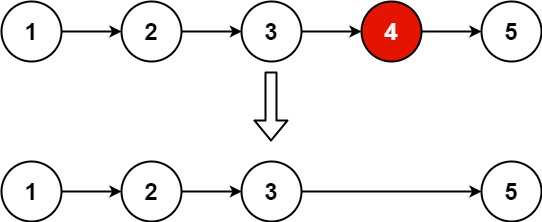
Given the head of a linked list, remove the nth node from the end of the list and return its head.

Example 1:

image

Input: head = [1,2,3,4,5], n = 2 Output: [1,2,3,5]

Example 2:

Input: head = [1], n = 1 Output: []

Example 3:

Input: head = [1,2], n = 1 Output: [1]

Constraints:

  • The number of nodes in the list is sz.
  • 1 <= sz <= 30
  • 0 <= Node.val <= 100
  • 1 <= n <= sz

Follow up: Could you do this in one pass?

/**
* Definition for singly-linked list.
* struct ListNode {
* int val;
* ListNode *next;
* ListNode() : val(0), next(nullptr) {}
* ListNode(int x) : val(x), next(nullptr) {}
* ListNode(int x, ListNode *next) : val(x), next(next) {}
* };
*/
class Solution {
public:
ListNode* removeNthFromEnd(ListNode* head, int n) {
ListNode* slow = head;
ListNode* fast = head;
for(int i = 0; i < n; i++) {
fast = fast->next;
}

if(!fast) return head->next;

while(fast && fast->next) {
slow = slow->next;
fast = fast->next;
}
slow->next = slow->next->next;
return head;
}
};
  • T: $O(N)$
  • S: $O(1)$