跳至主要内容

271. Encode and Decode Strings

· 閱讀時間約 1 分鐘
class Codec {
public:

// Encodes a list of strings to a single string.
string encode(vector<string>& strs) {
string res = "";
for (auto& a : strs) {
// 轉成size/字串size/字串size/字串
// ["Hello","World"] -> 5/Hello5/World
res.append(to_string(a.size())).append("/").append(a);
}
return res;
}

// Decodes a single string to a list of strings.
vector<string> decode(string s) {
vector<string> res;
int i = 0;
while (i < s.size()) {
// 找到分隔號的位置
auto found = s.find("/", i);

// 得到字串長度
int len = stoi(s.substr(i, found - i));

// 將字串推到 array
res.push_back(s.substr(found + 1, len));

// 下一根指針
i = found + len + 1;
}
return res;
}
};

// Your Codec object will be instantiated and called as such:
// Codec codec;
// codec.decode(codec.encode(strs));
  • T: $O(N)$
  • S: $O(N)$

268. Missing Number

· 閱讀時間約 1 分鐘

Sort

class Solution {
public:
int missingNumber(vector<int>& nums)
{
int n = nums.size();
for(int i = 0; i < nums.size(); i++)
{
n += i - nums[i];
}
return n;
}
};
  • T: $O(n)$
  • S: $O(1)$

261. Graph Valid Tree

· 閱讀時間約 1 分鐘
class Solution {
public:
bool validTree(int n, vector<vector<int>>& edges)
{
vector<vector<int>> graph(n, vector<int>());
for (auto& edge : edges)
{
graph[edge[0]].push_back(edge[1]);
graph[edge[1]].push_back(edge[0]);
}

unordered_set<int> seen;
return dfs(graph, seen, 0, -1) && seen.size() == n;
}

bool dfs(vector<vector<int>>& graph, unordered_set<int>& seen, int node, int parent)
{
if (seen.count(node)) return false;

seen.insert(node);

for(int nei : graph[node])
{
if (parent != nei)
{
if (!dfs(graph, seen, nei, node))
return false;
}
}
return true;
}
};
  • T: $O(V + E)$
  • S: $O(V + E)$

257. Binary Tree Paths

· 閱讀時間約 2 分鐘

Given the root of a binary tree, return all root-to-leaf paths in any order.

A leaf is a node with no children.

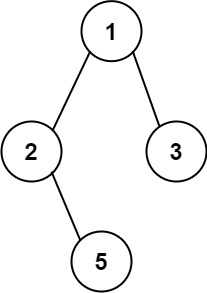
Example 1:

image

Input: root = [1,2,3,null,5] Output: ["1->2->5","1->3"]

Example 2:

Input: root = [1] Output: ["1"]

Constraints:

  • The number of nodes in the tree is in the range [1, 100].
  • -100 <= Node.val <= 100

recursion

/**
* Definition for a binary tree node.
* struct TreeNode {
* int val;
* TreeNode *left;
* TreeNode *right;
* TreeNode() : val(0), left(nullptr), right(nullptr) {}
* TreeNode(int x) : val(x), left(nullptr), right(nullptr) {}
* TreeNode(int x, TreeNode *left, TreeNode *right) : val(x), left(left), right(right) {}
* };
*/
class Solution {
public:
vector<string> binaryTreePaths(TreeNode* root) {
vector<string> res;
dfs(root, "", res);
return res;
}

void dfs(TreeNode* root, string out, vector<string>& res) {
if(!root->left && !root->right) {
res.push_back(out + to_string(root->val));
}
if(root->left) {
dfs(root->left, out + to_string(root->val) + "->", res);
}
if(root->right) {
dfs(root->right, out + to_string(root->val) + "->", res);
}
}
};
  • T: $O(N)$
  • S: $O(N)$

iteration

/**
* Definition for a binary tree node.
* struct TreeNode {
* int val;
* TreeNode *left;
* TreeNode *right;
* TreeNode() : val(0), left(nullptr), right(nullptr) {}
* TreeNode(int x) : val(x), left(nullptr), right(nullptr) {}
* TreeNode(int x, TreeNode *left, TreeNode *right) : val(x), left(left), right(right) {}
* };
*/
class Solution {
public:
vector<string> binaryTreePaths(TreeNode* root) {
vector<string> res;
// base case
if(!root) return res;

// 如果沒有左右子節點,則返回 root
if(!root->left && !root->right) {
return {to_string(root->val)};
}

// 找左側
for(auto s : binaryTreePaths(root->left)) {
res.push_back(to_string(root->val) + "->" + s);
}

// 找右側
for(auto s : binaryTreePaths(root->right)) {
res.push_back(to_string(root->val) + "->" + s);
}

return res;
}
};
  • T: $O(N)$
  • S: $O(N)$

253. Meeting Rooms II

· 閱讀時間約 1 分鐘

Given an array of meeting time intervals intervals where intervals[i] = [starti, endi], return the minimum number of conference rooms required.

Example 1:

Input: intervals = [[0,30],[5,10],[15,20]] Output: 2

Example 2:

Input: intervals = [[7,10],[2,4]] Output: 1

Constraints:

  • 1 <= intervals.length <= 104
  • 0 <= starti < endi <= 106
class Solution {
public:
int minMeetingRooms(vector<vector<int>>& intervals) {
int n = intervals.size();

sort(intervals.begin(), intervals.end());
priority_queue<int, vector<int>, greater<int>> minHeap;

// #0: minHeap = [30];
// #1: minHeap = [10, 30];
// #2: minHeap = [10, 20];
for (auto& interval : intervals) {
if (!minHeap.empty() && interval[0] >= minHeap.top()) {
minHeap.pop();
}
minHeap.push(interval[1]);
}
return minHeap.size();
}
};
  • T: $O(N \log N)$
  • S: $O(N)$

252. Meeting Rooms

· 閱讀時間約 1 分鐘

Given an array of meeting time intervals where intervals[i] = [starti, endi], determine if a person could attend all meetings.

Example 1:

Input: intervals = [[0,30],[5,10],[15,20]] Output: false

Example 2:

Input: intervals = [[7,10],[2,4]] Output: true

Constraints:

  • 0 <= intervals.length <= 104
  • intervals[i].length == 2
  • 0 <= starti < endi <= 106

算區間是否重疊,如果重疊 return false

class Solution {
public:
bool canAttendMeetings(vector<vector<int>>& intervals) {
int n = intervals.size();
if (n == 0) return true;
sort(intervals.begin(), intervals.end());
for(int i = 0; i < n - 1; i++) {
// 如果目前區間的 endtime 比下一個區間的 start time 大的話
// 代表有 overlap
if (intervals[i].back() > intervals[i + 1].front())
return false;
}
return true;
}
};
  • T: $O(N \cdot \log N)$,取決於排序演算法
  • S: $O(1)$

242. Valid Anagram

· 閱讀時間約 1 分鐘
class Solution {
public:
bool isAnagram(string s, string t)
{
if (s.size() != t.size()) return false;

unordered_map<char, int> m;

for(auto& c : s) ++m[c];

for (auto& c : t)
{
if (m.count(c))
{
--m[c];
if (!m[c]) m.erase(c);
}
}
return !m.size();
}
};
  • T: $O(N)$
  • S: $O(1)$

239. Sliding Window Maximum

· 閱讀時間約 2 分鐘
  • 在一個整數陣列中,找到每個滑動視窗中的最大值。函式接收兩個參數:一個是整數陣列 nums,另一個是滑動視窗的大小 k
  • 初始化一個 deque q,用來儲存滑動視窗中有潛力成為最大值的元素的 index。

deque

class Solution {
public:
vector<int> maxSlidingWindow(vector<int>& nums, int k)
{
int n = nums.size();
vector<int> res;
deque<int> q;

for (int i = 0; i < n; ++i)
{
// 因為滑動視窗會向前移動
// 當 q.front() 的元素離開視窗的時候
// 1 [3 -1 -3]
// ^ ^
// <- k -> i
if (!q.empty() && q.front() + k == i)
{
q.pop_front();
}

// 當發現 deque 尾端的元素比目前的 nums[i] 小的時候
// pop 掉,因為不可能成為最大值
// 所以 deque 裡面會存有潛力成為最大值數字的 index
while (!q.empty() && nums[q.back()] < nums[i])
{
q.pop_back();
}

// 將 index push 到 queue
q.push_back(i);

// 當發現 i + 1 >= k 的時候
// 代表滑動視窗的大小 k 已經形成
// 則將最大值 nums[q.front()] 推到 res
if (i + 1 >= k)
{
res.push_back(nums[q.front()]);
}
}
return res;
}
};
  • T: $O(n)$
  • S: $O(k)$

priority queue

class Solution {
public:
vector<int> maxSlidingWindow(vector<int>& nums, int k)
{
vector<int> res;

// 預設由大排到小
priority_queue<pair<int, int>> q;

for (int i = 0; i < nums.size(); ++i)
{
while (!q.empty() && q.top().second <= i - k)
{
q.pop();
}

// {存數字, 存 index}
q.push({nums[i], i});

// 如果滑動視窗形成
// 將最大值 push 到 res
if (i >= k - 1)
{
res.push_back(q.top().first);
}
}
return res;
}
};
  • T: $O(n)$
  • S: $O(k)$

238. Product of Array Except Self

· 閱讀時間約 2 分鐘

Hint

class Solution {
public:
vector<int> productExceptSelf(vector<int>& nums)
{
// Initialize a vector to store the products of elements to the left of each index
// Initialize a vector to store the products of elements to the right of each index
// Initialize a vector to store the final result

// Compute the products of all elements to the left of each index
for ()
{
// Each element in arr1[i+1] is the product of all elements before nums[i+1]
}

// Compute the products of all elements to the right of each index
for ()
{
// Each element in arr2[i-1] is the product of all elements after nums[i-1]
}

// Compute the final result by multiplying the corresponding elements of arr1 and arr2
for ()
{
// The product of all elements except nums[i] is arr1[i] * arr2[i]
}
// Return the result vector
}
};
class Solution {
public:
vector<int> productExceptSelf(vector<int>& nums)
{
int n = nums.size();
vector<int> left(n, 1);
vector<int> right(n, 1);
vector<int> res(n);

for (int i = 0; i < n - 1; ++i)
{
left[i + 1] = left[i] * nums[i];
}

for (int i = n - 1; i > 0; --i)
{
right[i - 1] = right[i] * nums[i];
}

for (int i = 0; i < n; ++i)
{
res[i] = left[i] * right[i];
}
return res;
}
};
  • T: $O(N)$
  • S: $O(N)$

Hint - Space Improved

class Solution {
public:
vector<int> productExceptSelf(vector<int>& nums)
{
// Initialize the result array with 1s, as we will be using multiplication.

// First pass: calculate the product of all elements to the left of each index.
for ()
{
// res[i] will be the product of all elements to the left of i.
}

// Variable to store the product of all elements to the right of the current index.
// Second pass: calculate the product of all elements to the right of each index and
// multiply it with the product from the first pass.
for ()
{
// Multiply with the product of elements to the right.
// Update the right product for the next iteration (one index to the left).
}
}
};
  • Space Improved
class Solution {
public:
vector<int> productExceptSelf(vector<int>& nums)
{
int n = nums.size();
vector<int> res(n, 1);

for (int i = 1; i < n; ++i)
{
res[i] = nums[i - 1] * res[i - 1];
}

int right = 1;
for (int i = n - 1; i >= 0; --i)
{
res[i] *= right;
right *= nums[i];
}
return res;
}
};
  • T: $O(N)$
  • S: $O(1)$